(CNN) America is stirring, however it’s every state for itself.
May 1 brings an easing of stay-at-home orders as around half the states in the union move toward a resumption of daily life, or what will pass for it in the immediate future, in the next few days.
An overwelming patchwork of openings and brand-new distancing guidelines for dining establishments, workplace, churches, oral practices and even fitness centers in some places will allow daily commerce to resume– whether workers and clients are prepared or not.
The easing of constraints comes in spite of the fact that few, if any states, please the White Home standards of declining infections for 14 straight days before opening is pondered. Some states, nevertheless, have flattened the curve of the pandemic.
The nation’s leading infectious illness professional cautioned states Thursday night not to deviate too much from the White House standards. “The discretion is given to the governors. They know their states, the mayors know their cities, so you wish to give them a little wiggle room. My recommendation is, you understand, do not wiggle too much,” Dr. Anthony Fauci stated during CNN’s coronavirus international town hall.
The momentum towards spying open restaurants, organisations and stores is happening regardless of the Trump administration’s failure to construct a thorough testing network efficient in screening countless people a week, which epidemiologists state is important to stopping a renewal of the novel coronavirus.
That makes Friday and the next few weeks a moment of overwhelming reckoning as the country waits to see whether the opening releases a second wave of infections that runs out of control.
If it does, Americans may deal with the prospect of a go back to stay-at-home orders that might destroy an economy that is already in tatters with more than 30 million people suddenly out of work.
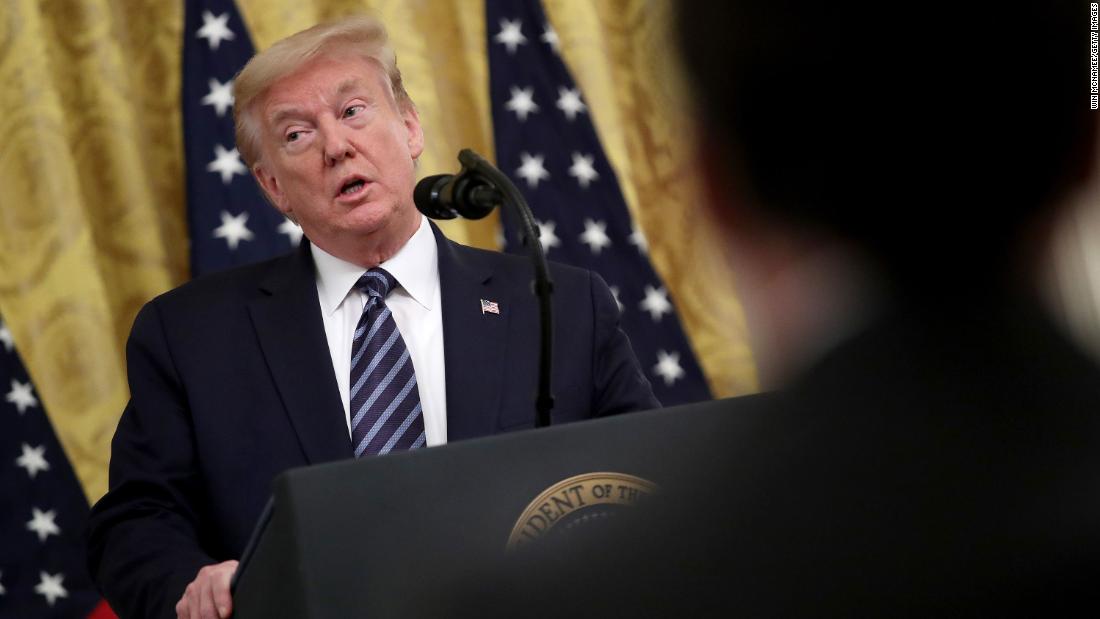
President Donald Trump, nevertheless, is itching to get out of Washington to offset wasted time in his reelection campaign, after claiming Thursday that his unpredictable and vengeful management at a time of national crisis had been a “magnificent” success.
He plans to travel to the swing state of Arizona next week– even at the rate of his vanity if he has to cover his face.
” Should I speak in a mask? You are going to need to inform me if that is politically correct,” the President told press reporters Thursday.
The state reopenings suggest progress, however their staggered nature is likewise an indication of how far the country has to go to beat the pandemic.
” Things are improving and we can slowly resume some activities,” Thomas Frieden, the former director of the Centers for Illness Control and Prevention, stated on Thursday at an Aspen Institute forum.
” On the other hand, we’re returning, not to regular, we’re going to get back to a new regular. Which’s going to include physical distancing, hand sanitizer, face masks and avoidance … of big gatherings where lots of people come together in one place,” he said.
Still, Frieden warned that the longer battle versus the pandemic, which he referred to as the worst public health threat in 100 years, is “just starting.”
A pandemic respects no state borders, and there is a real opportunity that specifies taking a threat by opening might ultimately make the circumstance worse for all the others.
A blended picture of openings and extended constraints
In one sense, the staged openings represent federalism at work– as regional power in states throughout a large country is used to regional situations without regulations from a remote federal government in Washington.
States including Texas, West Virginia, Utah, Arkansas and Georgia are approaching different stages of reopening in the coming days. Others like Ohio, where Gov. Mike DeWine has moved slower to rave reviews, Arizona and Minnesota are extending lockdowns. Constraints in Michigan drove protesters, consisting of some who were equipped, into the state Capitol on Thursday. And New York City, New Jersey and California stay frozen in a cycle of death– even if their pandemics have plateaued. A growing hazard to the nation’s food supply and a few of its most susceptible workers is on the other hand aggravating, as more meat-processing plants reported mass infections of personnel.
Still, in the middle of the tragedy, little pockets of hope are opening throughout the land. The medical facility ship USNS Comfort, sent out to help New York in its darkest hour, slipped its berth and headed into the Atlantic for its voyage house to Virginia. The NASCAR racing series and horse racing on Churchill Downs in Kentucky are set to resume in a couple of weeks– albeit without spectators. Golf players will soon be teeing off once again in Dallas.
As states open, governors, mayors and community leaders will be accountable for the life-and-death choices included with a vicious virus with no proven remedies and vaccines still at big.
In many ways, that’s how the United States system of government– and embedded suspicion of federal authority– says it should be.
However the big unknown is how the general public, which polls reveal is still deeply cautious of returning outside, will respond. That reticence is one reason– along with regulations like much reduced capability at restaurants– why the soaring economic rebound that the President is predicting is not likely to happen, at least at the start.
State openings hint at absence of national strategy
The jumble of conflicting constraints, shelter-in-place orders, partial openings and organisations firing up, also shows the utter lack of a meaningful national technique on the pandemic.
Trump has actually made quite clear that he sees it as the job of states to scale up testing and to provide their medical facilities with protective gear while bringing the country back on line.
The federal government ought to simply be a back up, he states.
That mindset, and Trump’s botched call that the infection would never ever threaten the US, have intensified the pandemic in the United States, which has eliminated more than 60,000 Americans and infected more than a million in just a couple of months.
It has forced states to compete versus one another, the federal government and foreign nations for individual protective devices for medical professionals and nurses on the front lines.
And it resulted in the amazing spectacle of Maryland Republican politician Gov. Larry Hogan ordering state police and the national guard to safeguard coronavirus screening packages he imported from South Korea– consisting of from the federal government.
The lack of reliable management from Washington has actually persuaded some states– in the northeast, the Midwest and the Pacific coast– to band together to collaborate on issues like when to open up and to negotiate with the federal government.
Trump becomes less appropriate
In numerous ways, the states-led opening effort sidelines the President and makes his everyday statements and contradictions less pertinent and a sideshow to the primary act.
If his reelection does depend upon a restored economy, his fate might remain in the hands of state governors, including those Republicans who jumped at his support to open.
However Trump might also benefit politically from the arms-length approach, which coincides with an end to his untamed daily briefings that aides feared were hurting his reelection chances.
If states do well and infections do not suddenly peak once again, the President will make certain to declare a share of the credit. If reopenings are a disaster, Trump will at least have some distance from private decisions by state leaders– even if the nation will remember his pressure to get things moving again.
Trump’s canceled daily briefings this week have likewise suggested less presence for senior public health authorities like Dr. Anthony Fauci and Dr. Deborah Birx, whose science-based care has actually in some cases diminished his favored story of a light at the end of the tunnel.
However the lack of a coordinated federal effort does significantly raise the risk of the patchwork state openings and might eventually slow the nation’s introduction from the crisis.
” If we wish to handle this, we’ll require an extensive technique. That technique indicates we protect health care, we reinforce public health, we develop parts of society, so we can reopen and resume and recuperate as rapidly as possible without a rebound in cases,” Frieden stated.
” We need a thorough method,” he highlighted, describing a goal that may be too much to expect from a disorderly administration that is more thinking about claiming undeserved credit for its pandemic management than laying out brand-new strategies.
” I think I have actually managed it– and not me; I think our whole group has actually been spectacular,” Trump said Thursday, highlighting in particular the non-emergence of a when feared ventilator shortage.
A circumstance in which numerous states are open and some are not will heighten the next massive political fight in Washington– how to save revenue-deprived state governments following pleas from guv’s mansions populated by both Democrats and Republicans.
” They happen to be Democratic states. It’s California, it’s New york city, it’s Illinois, you start with those 3. And the Republican states remain in strong shape. You understand, I don’t understand, is that luck or talent? Or is it just a various mentality?” Trump stated.
https://www.thenewsedge.com/2020/05/01/state-openings-bring-risks-substantial-stakes-for-america-and-its-president/
Comments
Post a Comment